Resilient Logistics for Resilient Supply Chains: Insights from EU Projects

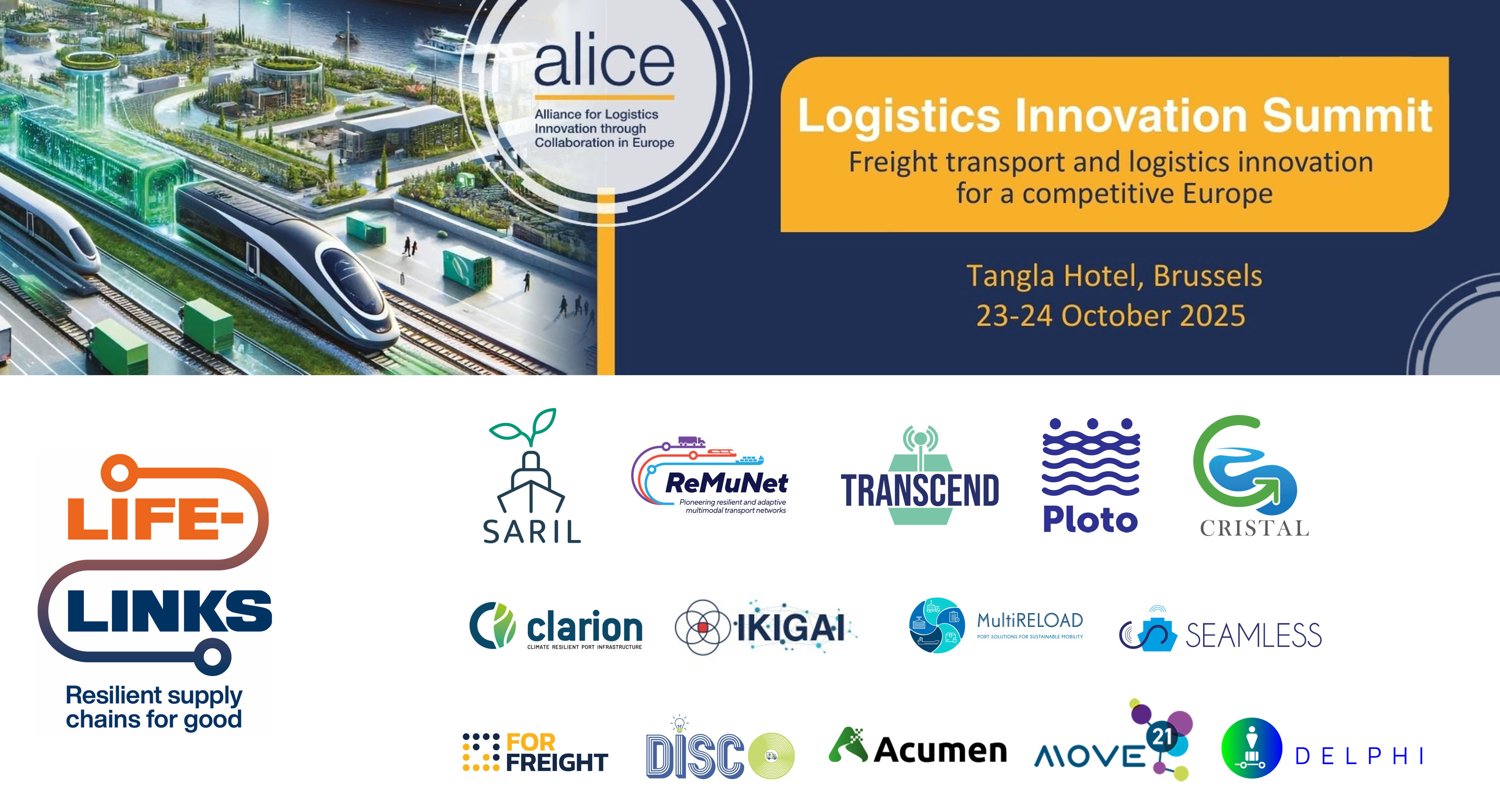
The ALICE Logistics Innovation Summit 2025 on 23-24 October in Brussels was a treat for anyone interested in the intersection between logistics, resilience, climate, and the physical internet. This connects directly with the focus of the Life-Links Framework that I presented at the summit: collaborative action to strengthen the transport and logistics links that underpin supply chains.
Several Horizon Europe projects managed or supported by ALICE are already applying similar thinking. These projects show that resilience of logistics systems is increasingly embedded across EU research and innovation – sometimes directly, sometimes as an indirect co-benefit. Strengthening the logistics links and systems ultimately benefits the wider supply chains and the companies, countries, communities and consumers that depend on them. Here are the most relevant ones:
Projects that work directly on improving resilience of logistics systems and infrastructure to climate and other threats:
-
SARIL (Sustainability and Resilience for Infrastructure and Logistics networks): develops models and KPIs for logistics systems to deal with floods, extreme weather and cyber-attacks, to maintain supply chain continuity. Models are applied at different geographical levels, including regional (Alpine region), national (Spain), and global/EU (Suez Canal, New Silk Road).
-
ReMuNet (Resilient Multimodal freight Transport Network): combines collaboration between logistics actors and authorities, synchromodal (= real-time) logistics planning and AI to manage disruptions. It focuses on two corridors: humanitarian supplies from the North Sea/Baltic to Ukraine and multimodal transport along the Rhine–Danube.
-
TRANSCEND (Transport Resilience against Cyber and Non-Cyber Events to prevent network disruption) establishes a digital platform as a “control tower” for freight transport operators to detect physical and cyber risks and develop a resilience plan. Pilots include a seaport (Valencia-Zaragoza), inland port (Budapest), airport (Luxembourg), rail-road terminal (Bologna), and highway transfer hub (Egnatia, Greece).
-
PLOTO (Digital Platform and Analytical Tools for Environmentally Sustainable and Resilient Inland Waterway Transport): modelling and digital technologies to inform assessment, decisions, and identification of measures that improve the resilience of inland waterways (IWW) and connected land infrastructure to extreme weather, accidents and other hazards. Tools and services (e.g. modelling, remote sensing, digital twins, early-warning systems) are tested for IWW infrastructure in Belgium, Hungary and Romania.
-
CLARION (Climate Resilient Port Infrastructure) enhances resilience, sustainability, and security of European ports in the face of climate change through improved infrastructure, operations and response to disruptions. Ten pilots at the ports of Antwerp-Bruges, Constanța, Hamburg and Rotterdam focus on port infrastructure and their connected inland waterways and transport network.
-
CRISTAL (Climate resilient and environmentally sustainable transport infrastructure, with a focus on inland waterways): improves the reliability, and thus resilience, of inland water transport including during extreme weather. Strategies include real-time monitoring of water levels and hydrological conditions, synchromodal transport corridor management system, and redefined logistics processes, which are piloted at sites in Poland, Italy and France
Projects that improve multimodal connectivity, reliability and interoperability, which contribute to resilience of Europe’s Ten-T network
-
IKIGAI (Physical Internet and the Key Steps to Innovation-driven Supply Chain Transformation towards Green, Affordable, Scalable and Collaborative Zero-Emissions Freight Transport Solutions): accelerates the realization of the Physical Internet by developing shared, modular and interoperable logistics systems and data standards that enhance efficiency, resilience and decarbonization across hubs, corridors and cities.
-
MultiRELOAD (Multimodal Resilient Freight Transport Hubs and Corridors for a Sustainable and Scalable Logistics System) increases operational efficiency, safety and reliability of inland ports as multimodal freight nodes through digitalization to shift freight from road to rail and inland waterways, with pilots for Duisburg, Vienna and Basel.
-
SEAMLESS (Safe, Efficient and Autonomous: Multimodal Library of European Shortsea and inland Solutions): integrates autonomous systems (cargo shuttles, vessels, shore-side infrastructure) into short sea shipping and inland waterways transport with the aim to shift road freight movements to hinterland waterways.
-
FOR-FREIGHT (Flexible, Multimodal and Robust Freight Transport) develops digital solutions to optimize multimodal freight transport, resilience, and its costs, with pilots for Valencia seaport to last mile (blockchain & digital twins), Athens’ airport to seaport (decision support systems and real-time monitoring), and Romania’s Danube River port to rail (Internet of Things & data processing solutions).
Projects that improve resilience of urban passenger and freight transport through better data sharing, strategies and decisions
-
DISCO (Data-driven, Integrated, Synchromodal, Collaborative and Optimised urban freight meta model): tests 23 data-driven solutions for flexible use of urban spaces that support both passenger and freight transport, covering curbsides, buildings, last mile, modes and data-collection methods.
-
ACUMEN (AI-aided decision tool for seamless multimodal network and traffic management): creates an AI-based decision tool for information sharing, predicting and managing multimodal passenger and freight traffic, piloted in Athens, Amsterdam, Helsinki and Luxembourg.
-
MOVE21 (Multimodal and Interconnected Hubs for Freight and Passenger Transport Contributing to a Zero-Emission 21st Century): integrates policies, infrastructure (physical and digital), vehicles and energy to reduce emissions and improve resilience of passenger and freight transport. Pilots are carried out in six European cities: Bologna, Gothenburg, Hamburg, Munich, Oslo and Rome.
-
DELPHI (Federated network of platforms for passenger and freight Intermodality) designs a system for secure data sharing to improve coordination of passenger and freight transport in urban and metropolitan areas, piloted in Athens and Mykonos (Greece), Cluj-Napoca (Romania) and Madrid (Spain).
These projects already bring together many partners and ideas. Building on what is already happening, could we make their contribution to resilient logistics and resilient supply chains more visible? Could we explore how their pilots and cases could become practical examples of Life-Links Framework steps? Could we bring out resilience benefits for supply chains and wider economic, social and environmental co-benefits for its stakeholders?
I’d love to explore with ALICE and these project owners how to advance a goal shared with Life-Links: make logistics links more resilient for Resilient Supply Chains for Good.