ITF Summit 2026 side-event: Insurance for Resilient Transport
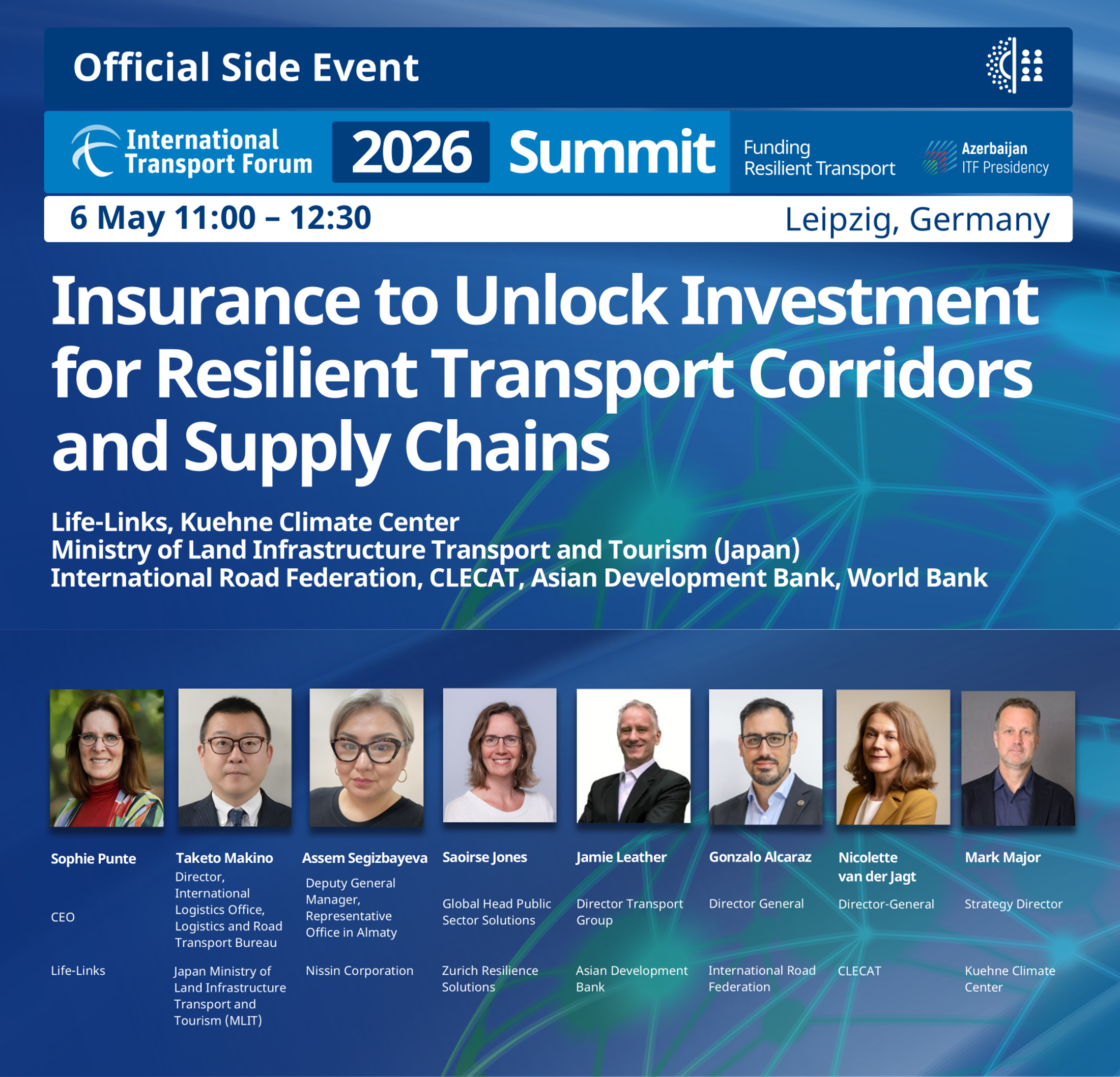
Official Side-Event 6 May 2026 ITF Summit 2026 “Funding Resilient Transport”
Organisers: Life-Links, Kuehne Climate Center, Ministry of Land Infrastructure Transport and Tourism (Japan), International Road Federation, CLECAT, Asian Development Bank, World Bank
Download Side Event Summary
Session Overview
International transport corridors and supply chains are facing more frequent disruption from extreme weather, geopolitical tensions, pandemics, conflict, and accidents. These risks affect transport infrastructure, logistics operations and workforces, and the movement of goods across the first, middle, and last mile. Strengthening the resilience of these systems will require sustained investment. Public funding alone will not be sufficient, and mobilising private capital is essential, particularly for transport corridors and public–private partnerships (PPPs). Insurance coverage is often a condition for such investment, yet growing losses and uncertainty have made many transport assets and operations harder or more expensive to insure. In many regions, insurers have withdrawn from higher-risk markets, raised premiums, or tightened coverage. Governments therefore struggle to attract private investment, while logistics, transport, and infrastructure operators, as well as shippers (manufacturers and retailers), face high insurance costs, coverage gaps, or operate with only partial insurance. These challenges are especially acute in emerging markets and high-risk corridors.
This session explored how insurance and reinsurance can help unlock private investment for transport network and supply chain resilience. It focused on insurance and reinsurance not only as mechanisms for transferring risk, but also as ways to support risk signalling, risk reduction, and more resilient investment decisions. Panel and breakout discussions examined potential insurance approaches across transport corridors, such as parametric and pooled solutions, and how investments that reduce risk can lead to lower premiums or improved coverage, helping to unlock both public and private capital, particularly in the context of PPPs. It also considered the roles that different stakeholder groups can play, in particular insurers and reinsurers; MDBs and DFIs working with governments; transport operators and customers/shippers; and NGOs and community actors. Results will feed into an Action Plan on insurance for resilient transport systems and supply chains that Life-Links and Kuehne Climate Center are developing.
The session was convened and moderated by Sophie Punte, CEO of Life-Links, and framed as a practical step toward that Action Plan. The discussion moved from stakeholder perspectives on insurance, resilience and insurability to breakout discussions on concrete actions, who should be involved, and what could realistically be started in the next 12–18 months.
Stakeholder Perspectives
The stakeholder perspectives bring together the opening remarks from Japan MLIT and Nissin Corporation and the panel discussion with representatives from insurance, development finance, road infrastructure and freight forwarding. Speakers were invited to reflect on where insurance comes in, how resilience fits, examples of where insurance could play a bigger role, and actions to improve resilience, bankability and insurability in transport corridors, logistics and supply chains.
Government perspective
Mr. Makino Taketo, Director, International Logistics Office, Logistics and Road Transport Bureau, Japan Ministry of Land Infrastructure Transport and Tourism (MLIT)
- Perspective: From the Government of Japan’s perspective, the key question is no longer whether resilience matters, but how to finance resilient transport systems.
- Challenge: Along the Middle Corridor, we are already seeing trade disruption risks such as border delays, customs bottlenecks, vessel shortages and limited port capacity. Climate risks are increasing too, including flooded rail links in Georgia, heavier snow in Kazakhstan and lower water levels in the Caspian Sea.
- Resilience need: Resilience can be strengthened in two ways: through better connectivity across existing routes, and through greater diversification through alternative routes and capacity.
- Insurance role: Insurance does not replace resilient design, but it is essential for long-term investment in trade corridors and logistics infrastructure. Japan’s scenario analysis for typhoons and floods shows that, as climate risks grow, insurers will need more reinsurance in the future.
- Example: Japan already includes insurance in its cooperation with other countries. Japan’s insurance corporation NEXI and Turkmenistan’s State Bank for Foreign Economic Affairs are cooperating on infrastructure projects. JICA cooperated with the Philippines to improve the insurance coverage of government assets against disaster risk.
- Action: Insurers should be involved earlier in project design, help improve corridor risk data and climate modelling, and engage more systematically with private-sector companies, while Japan can encourage closer coordination among JICA, development banks, and private insurers and reinsurers.
Logistics Service Provider perspective
Ms. Assem Segizbayev, Deputy General Manager, Representative Office in Almaty, Nissin Corporation
- Perspective: From the perspective of a logistics company, the Middle Corridor provides an alternative route between Japan and Europe, with Azerbaijan and Kazakhstan playing a crucial role in promoting its use.
- Challenge: There is still a significant lack of information in Japan on the Middle Corridor, while climate-related risks, such as severe weather and changing conditions around the Caspian Sea, can affect the reliability of the route.
- Resilience need: More operational data from actual shipments is needed to understand transport quality, route risks and reliability, especially as climate change and other disruptions affect transport more often.
- Insurance role: For logistics companies and their customers, cargo and liability insurance are most relevant; operational information can help insurers reduce uncertainty, support risk reduction and make coverage easier to provide. This matters because Japanese insurers currently cannot provide cover for cargo passing through Russia, Belarus, Ukraine or Iran.
- Example: Nissin participated in MLIT’s pilot project to test the feasibility of the Middle Corridor as a new transport option between Japan and Europe. In the two pilot shipments, data loggers collected information on temperature, humidity and vibration to understand transport quality, risks along the route and where reliability can be improved.
- Action: Gather more operational data from actual shipments on the Middle Corridor; strengthen cooperation between logistics companies and insurers so operational experience informs insurance decisions and risk reduction; and share the information more widely among corridor stakeholders.
Insurer perspective
Ms. Saoirse Jones, Global Head Public Sector Solutions, Zurich Resilience Solutions
- Perspective: From an insurer’s perspective, insurance companies are typically looked at as investors or underwriters, but they can also provide risk advisory and risk assessment.
- Challenge: Insurance companies are often brought in only to underwrite the risk that already exists and say: this is the coverage you can get, and this is the pricing for it. If risks have not been understood and reduced earlier, insurance can become too expensive or harder to obtain.
- Resilience need: Risk assessment should come earlier and look not only at current risk exposures, climate and non-climate related, but also at what those risks could look like 5, 10, 15, 20 or 30 years down the line.
- Insurance role: Insurers are in the risk management business: they understand the risks, the cost and impacts, and how to manage and prevent them. They can help assess risk across the supply chain and wider ecosystem, including specific assets, inputs, outputs and value-chain dependencies. They can then help quantify both the risks and the benefit of risk reduction measures.
- Example: After a production facility in Germany suffered major flood losses, Zurich Resilience Solutions mapped its flood risk exposure and other multi-hazard risks, and brought the company, railway infrastructure and the municipality to the table to identify risk reduction measures and the benefit in terms of avoided losses.
- Action: Bring insurers into risk management conversations from the get-go; use their risk assessment and engineering expertise to quantify risks, prioritise practical risk reduction measures and design future scenarios; and build policy and regulatory incentives so resilient design can gain traction and scale.
Multilateral development bank (MDB) perspective
Mr. Jamie Leather, Director Transport Sector Group, Asian Development Bank
- Perspective: From a development bank perspective, there is still a gap, but insurance is essential because the investment needs are huge, and the risks and impacts of those risks are getting much larger and broader.
- Challenge: Current investment is less than half of what is needed, while around $30 billion per year is lost from natural disasters in transport; much infrastructure was also designed or built before today’s rainfall levels and other risks were factored into design.
- Resilience need: It is not only about new infrastructure, but also about maintaining, operating and improving existing infrastructure, and prioritising critical transport links so that operations can continue when shocks occur.
- Insurance role: Insurance can support long-term operational sustainability by helping identify which risks need cover, what the appetite for those risks is, and what the impact would be if they materialise — from construction and operations to maintenance and upgrades.
- Example: ADB looked at ramp-up risk in the first two or three years of operations for railways or toll roads, where financial securities can help cover the risk that estimated volumes are not realised, so the project can still continue, and the financial model is not offset.
- Action: What is the true cost of inaction? Once that is realised, we may have a very different discussion. Better-informed decisions can then help prioritise investment, maintenance and upgrade decisions, and identify what kind of insurance cover could be allocated to those investments.
Road sector perspective
Mr. Gonzalo Alcaraz, Director General, International Road Federation
- Perspective: From the road sector perspective, insurance touches every stage of the road life cycle: engineers and consultants, construction, operations, concessions, users, equipment manufacturers and transport service operators.
- Challenge: Everyone affects each other’s exposure: something not well designed for flood, or a road that was well designed but poorly maintained, can have impacts on the rest of the system.
- Resilience need: For roads, resilience is about understanding how a road stays functional when disrupted, how maintenance prevents failures, whether there is redundancy on corridors, and whether actors are fast enough to respond and inform users.
- Insurance role: Insurance can help ask the right questions earlier in planning, feasibility and design, and bring together what different actors look for: thresholds for engineers, downtime for operators, reliability for freight users, and project performance for finance actors.
- Example: A motorway in a normally sunny holiday region in Europe faced heavy snow, showing that operational aspects such as closing the highway, informing users, coordinating emergency services and having snow equipment need to be considered before such events happen.
- Action: Bring insurance upstream into road planning, feasibility and design; use it to ask the right questions about future risks and service continuity; build a shared language across engineers, operators, freight users and finance actors; and include insurance in IRF’s road-sector work linked to the UN Decade of Sustainable Transport.
Freight forwarders’ association perspective
Ms. Nicolette van der Jagt, Director-General, CLECAT (European Association for Forwarding, Transport, Logistics and Customs Services)
- Perspective: From the freight forwarder perspective, the role is to look for alternatives and keep the supply chain moving when cargo is stuck or routes are disrupted.
- Challenge: Freight forwarders are dealing with many system breakages at the same time, including tariffs, climate impacts, congestion, cyber risk and geopolitical disruptions; these are not exceptions anymore, but situations seen over the last couple of years.
- Resilience need: As production becomes more diversified and partly more regionalised, freight forwarders need to be better connected and able to anticipate where problems may arise, stop thinking in silos, and find new solutions.
- Insurance role: The insurance question often comes afterwards: where are my contracts, am I still insured if I reroute, and to what extent are my cargo and assets insured? Even when insurance pays out, companies may still face added costs from delays, rerouting, detention, demurrage or longer transit times.
- Example: During the war in Ukraine, questions came up around the European Commission’s solidarity lanes, including whether cargo and assets were insured and to what extent this would determine whether companies could go into those areas.
- Action: Do more stress testing on supply chains; bring shippers, logistics service providers, carriers and insurers together; and develop practical checklists to educate the sector on critical nodes, IT systems, corridors, freight lanes and potential risks.
Participants input for the Action Plan
Participants discussed what actions should be included in an Action Plan to improve the resilience of transport corridors, supply chains and logistics through insurance, reinsurance or better conditions for insurability, who should be involved, and what could be started in the next 12–18 months.
- Bring insurance in earlier in infrastructure planning, feasibility, design, construction and operation, before risks are locked into projects.
- Define the full infrastructure lifecycle, from transport studies and design through construction, operation, maintenance and eventual decommissioning.
- Map supply chains and critical links to understand where goods may be lost, damaged or delayed, and where coverage is weaker.
- Identify risks and mitigation measures at each stage of the infrastructure or supply-chain lifecycle.
- Define acceptable risk or minimum resilience levels in relation to the cost of mitigation and the needs of users.
- Improve access to data and risk information by building on existing data, increasing transparency and sharing information across stakeholders.
- Use insurance-sector data more strategically, including insights on risk trends, premiums and insurance gaps, to shape the resilience and investment narrative.
- Develop a common rating system for assets, operations and systems based on climate and risk exposure, starting with infrastructure.
- Strengthen the business case for resilience investment by assessing the cost of inaction and identifying gaps where risks are not adequately covered.
- Integrate climate risk into financial modelling, including insurance costs and resilience considerations in ROI analysis and investment decisions, supported by targeted training for finance teams.
- Engage private-sector actors, policymakers and governments to identify where investment is needed and address political, regulatory or enforcement barriers.
- Promote a resilience mindset and stronger stakeholder communication, looking beyond individual assets to supply chains, inputs, outputs, energy, operations and follow-on impacts.
Closing Reflections
In closing, Mark Major, Senior Strategy Director at the Kuehne Climate Center reflected on how the discussion moved quickly from global issues such as macro trade lanes, wars and climate change to very practical things: a delayed shipment, a road that does not work, or an infrastructure project that takes too long. He emphasised the need for a better understanding of significant and growing long-term risks, and highlighted insurance expertise in understanding, quantifying and managing those risks.
He underlined that a key takeaway was bringing insurance in very early in the process, and taking a holistic view that covers not only infrastructure, but also operations, revenues and the multiple stakeholders involved, including companies with cargo and freight forwarders. He also pointed to the need to elevate the discussion to economic sustainability, so that the revenue implications of floods, landslides or snowstorms are considered from the beginning, when people are thinking about investment and returns.
Mark linked the discussion to the wider collaboration between Kuehne Climate Center and Life-Links, including the Life-Links Framework and its application to supply chains. The ideas from the session will be consolidated into an Action Plan on how to engage insurance in transport resilience processes, to be published ahead of COP31.