From Risk Intelligence to Resilience Capabilities
Protecting what societies need to stay free, safe and livable
On 5 May, the Netherlands celebrates Liberation Day. It is a day to remember freedom, but also to ask what freedom means to us today.
Freedom is not only the absence of war or occupation. It is being able to live with dignity, with family, friends and community around us. It is knowing that people have food and water, stay healthy, move freely, speak openly, can earn a living, and can trust that our society will still function tomorrow.
This is why a livable planet is not separate from liberty. Healthy natural systems make it possible for our society and economy to function, and for our freedom to endure.
But we are facing increasing risks. The World Economic Forum’s Global Risk Categories help us understand the landscape: geopolitical, economic, environmental, societal and technological risks. In its WEF Global Risks Report 2026, geoeconomic confrontation and state-based armed conflict rank as the biggest risks for the coming year. Technological risks, including cyber and AI, are rising. Environmental risks dominate the top three over ten years, while extreme weather ranks third for the coming year.
The WEF report also warns that global risks continue to grow in scale and speed, and that they increasingly interact. Conflict in the Middle East can raise energy prices, disrupt trade routes and threaten food security. A flood can damage infrastructure, disrupt supply chains and hurt local economies.
Governments and companies are trying to manage this, but it is getting harder. So the question cannot only be: which risk ranks highest this year? We also need to ask: what needs to keep working?
That is the shift from a risk lens to a resilience lens. The risk lens helps us understand what can go wrong. The resilience lens helps us protect the capabilities our society needs to keep functioning, especially when we cannot predict which risks will hit us, when they will happen, or what the impacts will be.
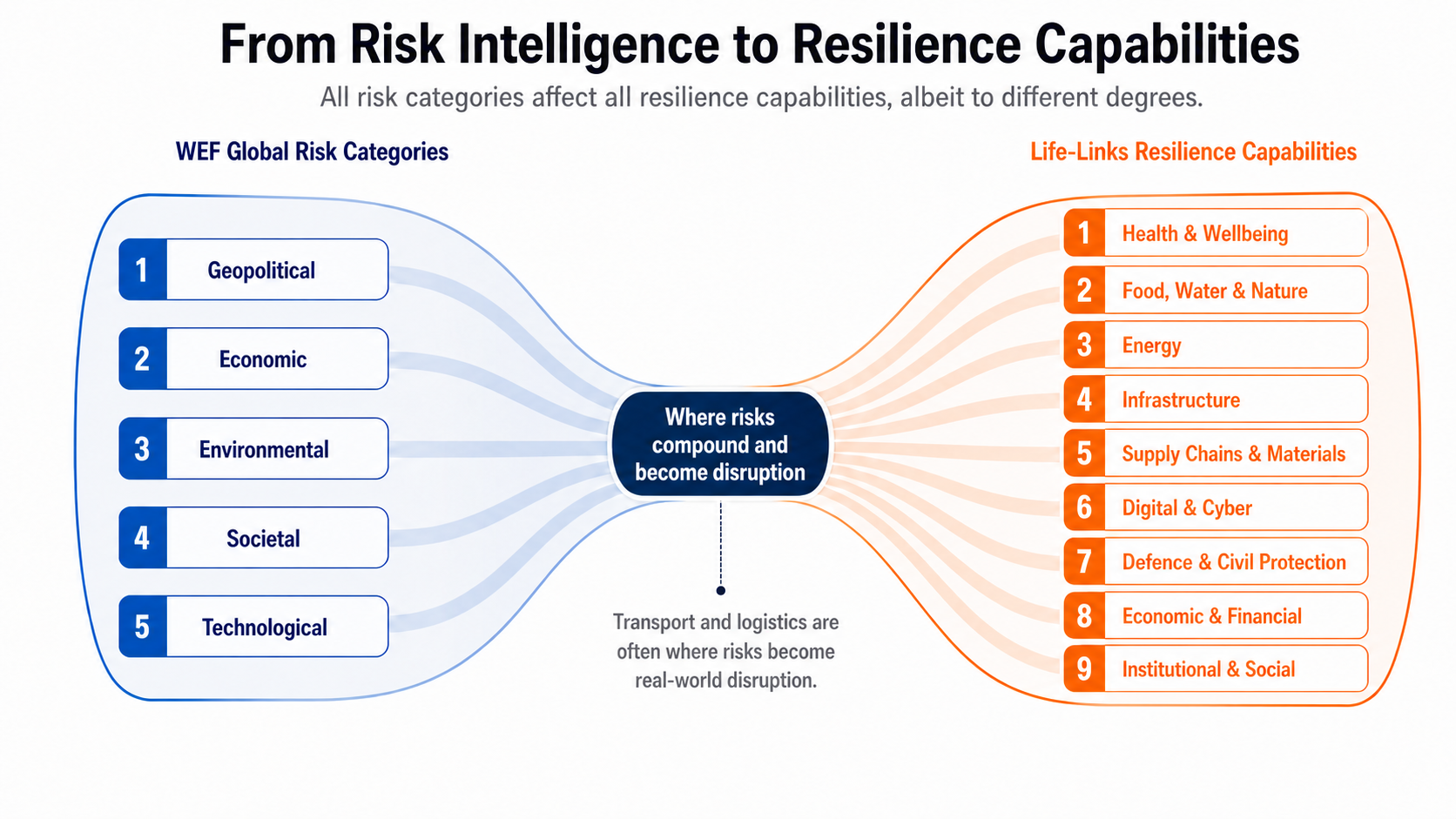
In the figure, the WEF categories on the left provide the risk lens, the middle shows where risks interact and become disruption, and the resilience capabilities on the right show what we need to strengthen. Transport and logistics are often where these risks become disruption, because they connect the systems people and economies depend on.
With Life-Links, I am trying to contribute to this wider resilience agenda by focusing on supply chain and logistics resilience. Supply chains are the lifelines of our economy and connect us all, creating a shared interest to keep them working. That makes them a potential force for collaborative action on resilience, climate and local sustainable development.
As I worked on applying this idea, I wondered whether strengthening supply chain resilience could also help build resilience elsewhere. Not in theory, but in practice: if a food supply chain becomes more resilient, does that also strengthen food security? If measures to strengthen a critical road or port also improve access to renewable energy, protect workers or keep trade moving, do they also contribute to energy, health or economic resilience?
This is why I defined nine Life-Links Resilience Capabilities: Health & Wellbeing; Food, Water & Nature; Energy; Infrastructure; Supply Chains & Materials; Digital & Cyber; Defence & Civil Protection; Economic & Financial; and Institutional & Social. I call them capabilities because they describe what society needs to keep functioning under stress. I call them Life-Links because they focus on the systems that keep our lives and societies functioning, and on the links between them. The sequence starts with human health and wellbeing, and then moves through the natural, physical, digital, economic and institutional systems that allow society to function.
This shifts the focus. Instead of mainly managing risks, policymakers, companies and others can ask which capabilities need strengthening, and which measures can create resilience gains in several places at once. As a result, we can build resilience to multiple risks across sectors, systems and natural assets.
Strengthening resilience capabilities helps us protect both, and gives people, companies and countries more freedom to shape what comes next. A livable planet and a free society belong together.