Transforming Transportation - why resilient supply chains and logistics matter

As Transforming Transportation focuses on “Powering Jobs and Growth” this week, resilience in supply chains and logistics should be central to the discussion.
Photo by Bernd Dittrich on Unsplash
How financiers look at disruption risk
Financing decisions still tend to focus on the transport asset. But what matters economically is whether that asset is a critical link in the wider movement of goods, incomes and trade. When a road, rail link, bridge or logistics hub fails, the impact is not limited to the asset itself. Supply chains and trade are disrupted, costs rise, incomes fall, and recovery can take much longer than expected. For finance, that matters.
This is where freight analytics help. They help turn disruption into concrete financial consequences that matter to a lender financing a railway, a port, or other freight assets. To estimate economic risks, financiers will usually look at three things before investing: reliability, redundancy and recovery.
- How reliable is the connection: how likely is freight movement to be disrupted? For example, routes via the Red Sea are exposed to armed conflict, while freight through the Panama Canal is slowed by recurring drought.
- How much redundancy is there: how quickly, and at what cost, can freight be rerouted? For example, a road segment in the North-South Economic Corridor in Laos has few alternatives because rail infrastructure is limited and the country has no seaports.
- How long does recovery take: how long does the loss last until the asset or route reopens, and until normal freight volumes and revenues return? Recovery can range from 6 days to clear the Suez Canal after the Ever Given blockage, to 78 days to reopen Baltimore’s channel after the bridge collapse, to almost 5 months to restore Porto Alegre airport after Brazil’s floods, and up to 1–2 years for freight volumes in the port of Rotterdam to return to normal after a systemic shock like COVID
Three things are missing
A stronger case for investing in critical links. The case for financing a transport or logistics asset is stronger when it can be shown to be a vulnerable critical link in a corridor or supply chain. Disruption at one transport or logistics link (e.g. a road segment or a port) can have effects far beyond the asset itself, spreading across the wider movement of goods. In the end, the costs are felt across the supply chain by manufacturers, retailers, and consumers. Identifying vulnerable critical links helps show why targeted resilience investments can generate wider economic benefits for supply chain actors and other stakeholders. A corridor or supply chain is only as resilient as its weakest link. The Life-Links Framework explains how collaboration around critical links can strengthen shared resilience.
The full societal cost of disruption. Financiers are first and foremost interested in financial risks to the borrower caused by disruption. This could be a government borrowing for a railway, or a port operator investing in a new terminal. They may also consider indirect economic losses within the wider logistics network where these feed back into the borrower’s performance. For example, a disrupted rail link can reduce revenue for the rail operator, raise costs for exporters, or weaken future demand for freight services. What is often missing is the wider cost to society, even though logistics systems and society are closely connected. Examples are higher prices for consumers, lost income for workers, farmers and drivers, and damage to livelihoods and natural resources.
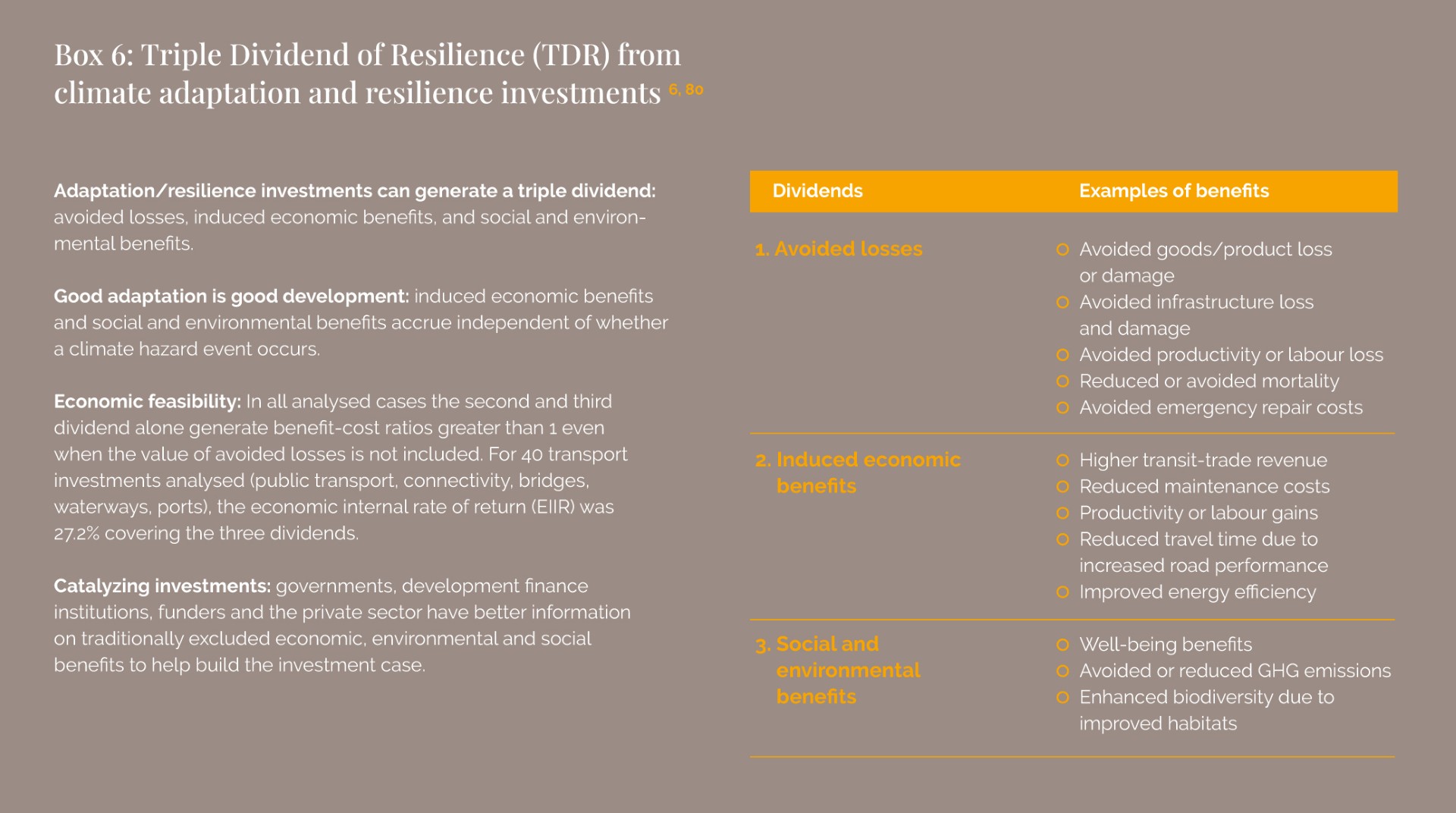
A broader definition of value from resilience. WRI, who co-organizes Transforming Transportation together with the World Bank, introduced a new way of looking at resilience. Resilience investments can generate a Triple Dividend of Resilience (TDR, as explained in the figure below): avoided losses (which is what financiers already look at), induced economic benefits, and social/environmental benefits. For example, an expressway rehabilitation in Manila, Philippines delivered additional dividends such as reduced congestion that allows more efficient business operation; alerts from the traffic management system for the whole population on weather and traffic congestion; and roadside trees that sequester carbon dioxide. In some cases, the investment case becomes even stronger when resilience goes hand in hand with decarbonization, for example through electrified rail or the introduction of electric trucks where these also improve reliability and reduce operating costs. Life-Links and Kuehne Climate Center are working on cases for avocado and coffee supply chains from Africa to Europe.
The climate crisis won’t disappear
I’m probably not the only one who has noticed that the framing of Transforming Transportation has moved away from climate change. Seen over time, the shift is hard to miss. In earlier editions, climate sat at the center of the conversation. In 2026, the main framing has moved toward jobs, growth and investment.
But climate risk has not become less relevant to transport. If anything, it is becoming more material. The latest WEF Global Risks Report, based on a survey of more than 1,300 experts, ranks extreme weather as the fourth most severe risk over the short term and the most severe over the next ten years.
Transport can only power jobs and growth if it can also withstand climate disruption. That is why resilient supply chains and logistics should remain central to the discussion, this week and beyond.