Part B. Life-Links Framework
B-1. Why this framework?
The Life-Links Framework provides a practical and forward-thinking way to tackle the urgent challenges of climate change by strengthening supply chains that people, companies, and economies rely on every day. Supply chains can be transformed from sources of vulnerability into drivers of collaborative climate action and local sustainable development – making them truly “resilient supply chains for good.”
Life-Links centers on vulnerable transport and logistics ‘links’ nodes/hubs and transport modes that connect them. Logistics links are critical parts of trade and supply chains connecting producers with consumers, but underrepresented in government NDCs and National Adaptation Plans (NAPs), corporate climate plans, and supply chain risk management tools and guidelines. Logistics system are looked at holistically and includes: network, infrastructure, operations and workforce, flows of goods, finance and information/data. The logistics system interacts with societal, regulatory, financial, physical and nature-based supporting systems.
 Part D-2: Logistics system and supporting systems
Life-Links leverages shared interests in supply chains to build partnerships that enable collaborative action and co-investment that strengthens resilience for all stakeholders. By applying this framework together, partners can make decisions and investments that individual actors would not pursue alone, leading to greater collective impact. Because each partner contributes uniquely tailored measures focused on transport and logistics, collective resilience is strengthened. In parallel, partners can unlock opportunities for reducing greenhouse gas (GHG) emissions and advancing sustainability as a co-benefit.
Life-Links helps deliver on the Paris Agreement by:
- Bridging adaptation, mitigation, and finance at the intersection of the Paris Agreement as areas that have often been addressed separately.
- Filling a gap on transport by contributing to the Sharm El-Sheikh Adaptation Agenda outcome: Transport infrastructure is resilient to climate hazards through the adoption of new technology, design and materials.35
- Connecting global policy objectives and NDCs and NAPs to private sector interests and local development needs and priorities
- Facilitating Global North–South cooperation based on a shared interest in trade, rather than risk pitting their interests against one another.
- Translating climate goals into real-economy outcomes: improved livelihoods, lower costs of living, economic growth, and business revenue.
- Positioning climate risks within the broader risk landscape faced by companies and countries, with a particular focus on vulnerabilities affecting supply chains.
- Connecting and contributing to on-the-ground implementation of three related global agendas, the Paris Agreement, the 2030 Sustainable Development Goals,55 and the Sendai Framework for Disaster Risk Reduction 2015-2030.56
Part D-3: Three Global Agendas
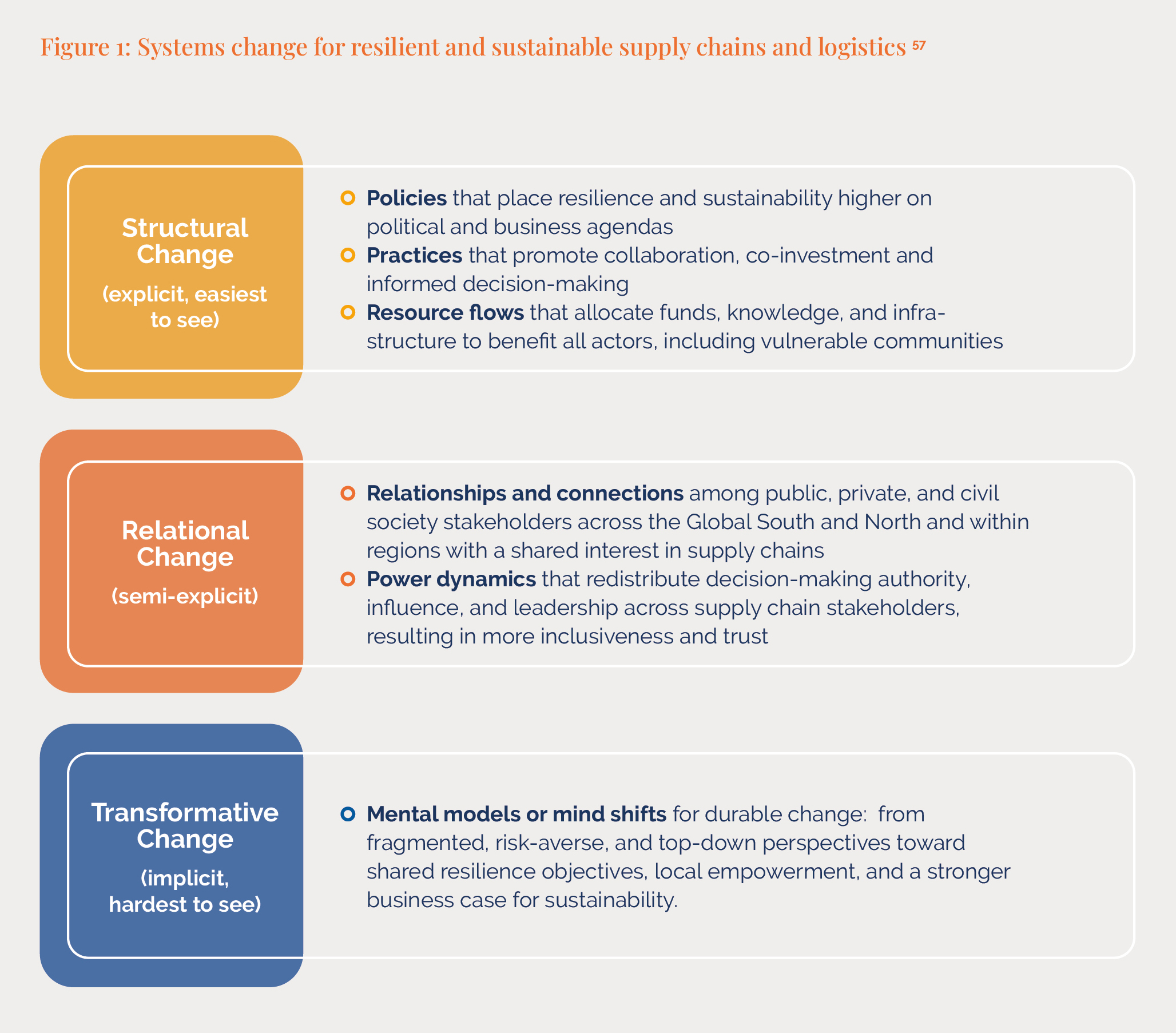
Ultimately, Life-Links aims to help bring about a systems change in supply chains and logistics, which requires working across multiple layers. In practice this means more than new policies or technical measures. To create resilient supply chains that last, we also need to rebalance power, nurture collaboration, and reshape the way people understand the problem itself. This is summarized in Figure 1, and with further details in Part D-4.57
Part D-4: Mind Shifts that enable Systems Change