Part C. Life-Links Steps
Step. 3 Implementation Plan with Partners
Outcome: Agreed implementation plan with feasible action measures that deliver value individually and added value together
Introduction: Collaboration
Partnerships working on project or initiative implementation often face serious challenges. Even when analysis has identified feasible action measures, it can be difficult to align priorities, secure financing, and agree on responsibilities. Questions such as “who pays what” and how to balance individual gains with collective benefits are common bottlenecks. Without a shared commitment and clear plan, even well-prepared packages risk stalling before they deliver impact. The Life-Links concept hinges on bringing companies on board to collaborate and co-invest in implementing feasible action measures. To enable this, three challenges must be overcome:
- Preference for control. Companies are more comfortable investing where they retain control. Their order of preference is: within their own company; with direct partners; in projects with a select group of partners; through industry-level alliances with peers; as part of multi-stakeholder platforms or networks; and finally at different levels and types of partnerships.90
- Risk delegation in supply chains. Multinational producers, manufacturers, and retailers (“shippers”) share logistics networks with many other companies and often delegate risk to their logistics service providers (LSPs). LSPs carry liability and face strict due-diligence requirements. Because they are bound by contracts with tight service-level agreements (SLAs), their risk exposure is heightened. Yet with thin margins and risks only partly insurable, they are unlikely to invest without strong customer backing.
- Difficult business case. Action measures reduce the risk of disruption – helping companies avoid potential losses rather than generate new revenue. For CFOs, such “insurance-like” investments are harder to justify than measures with a clear return on investment or tangible payback period.
To move past these barriers, Life-Links focuses on three things that make collaboration with companies possible:
- Focus on critical links. By concentrating on the most vulnerable parts of a supply chain rather than the whole supply chain or logistics network, measures become more concrete, manageable, and easier to justify in terms of resilience and decarbonization benefits.
- Mobilize diverse finance sources. Public finance, development partners, insurers, and private investors can all play a role in making resilience investments viable. This can range from government agencies upgrading roads, to development banks co-funding projects, to insurers offering parametric insurance, or blended finance arrangements that combine concessional and commercial capital. Together, these mechanisms help reduce risk for companies and make it more attractive for them to co-invest.
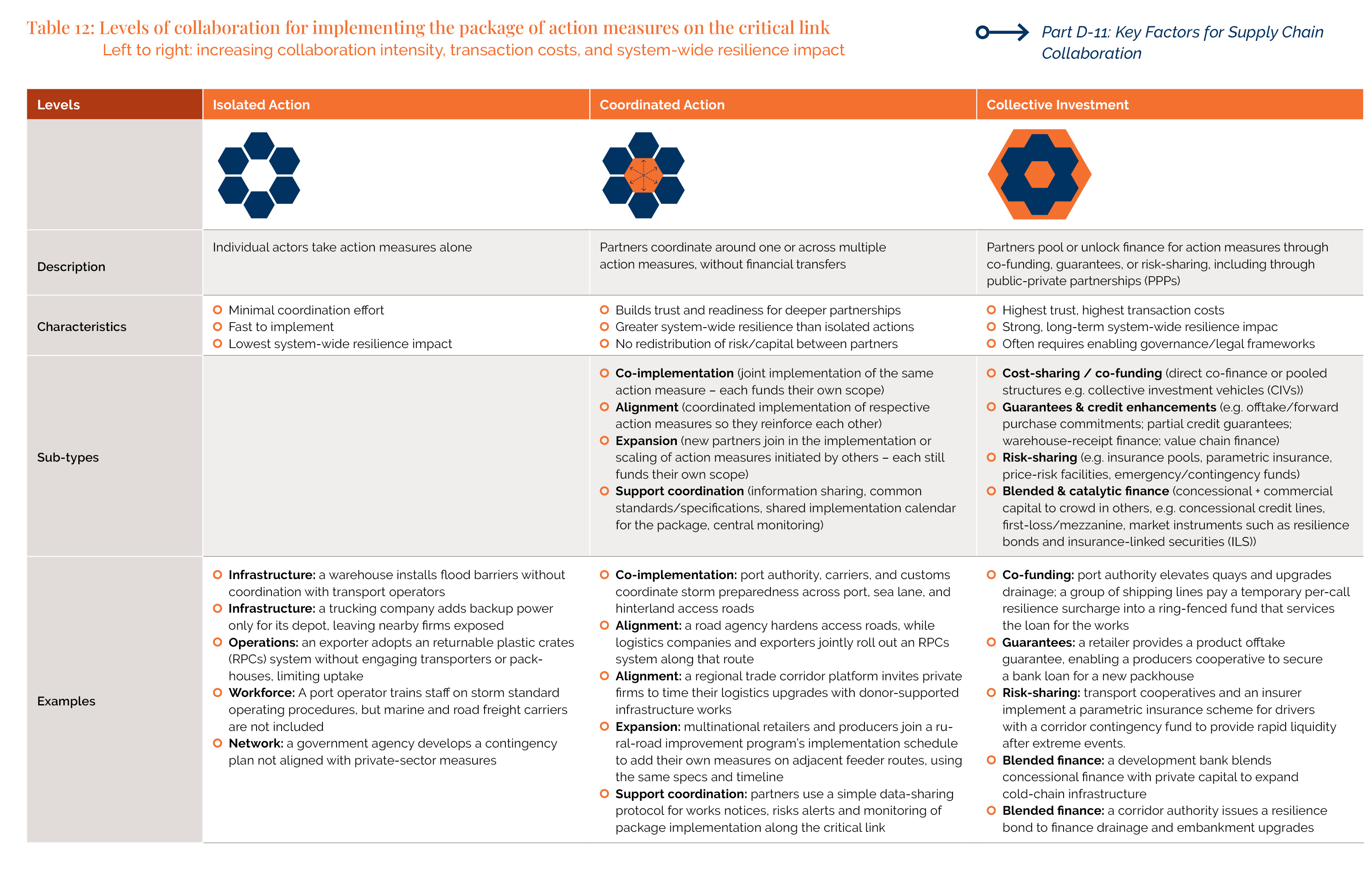
- Allow for flexible collaboration. Different measures within a package can be implemented in different ways - some coordinated separately, others jointly funded - while still holding together as a coherent package. This avoids leaving any measure as an isolated action. Table 12 illustrates this flexibility, showing the progression from isolated action to coordinated action to collective investment.
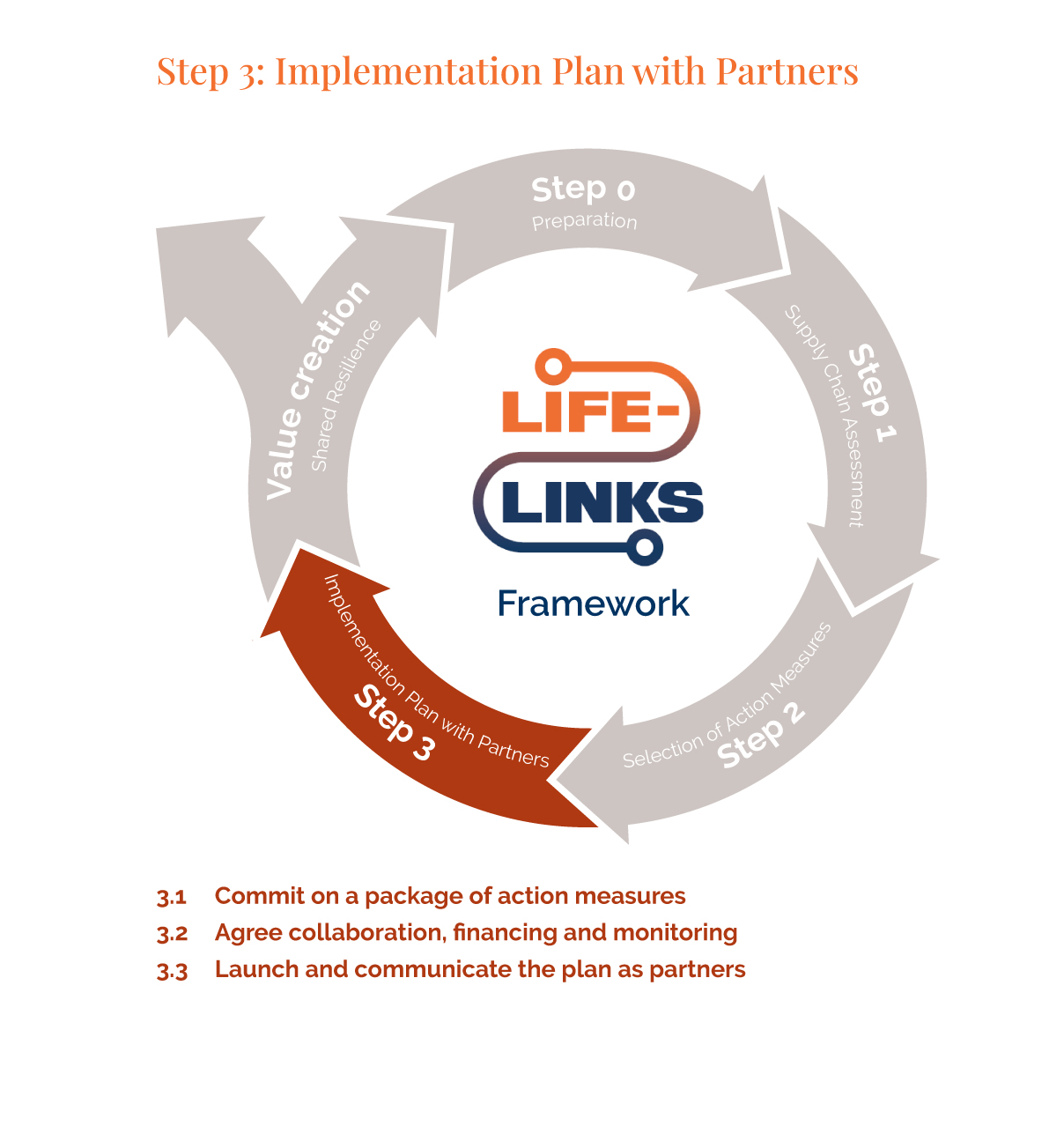
In this step, the proposed package of action measures is turned into a shared commitment and implementation plan. The process begins with agreeing on which measures from the proposed package will be taken forward and clarifying their value for different actors (sub-step 3.1). Partners then define how each measure will be implemented, including roles, financing, and monitoring arrangements (sub-step 3.2). Finally, the package is launched and communicated, making collaboration visible, building trust, and attracting further support (sub-step 3.3).
 Resource: Key Factors for Supply Chain Collaboration
3.1 Commit to package of action measures
Not all stakeholders will be direct partners in implementation, but the package and its business cases should consider the interests of all affected stakeholders to ensure broad benefits and avoid negative impacts. At this stage, supply chain actors commit in principle to a shared package of feasible action measures, confirming their collective intent and agreeing on broad principles of value and fair sharing of costs and benefits, which lays the foundation for building trust among partners.
a. Select measures from proposed package
Partners take a critical look at the proposed package from Step 2 and decide which action measures are most feasible and resilience-effective for the critical transport links, while also offering opportunities for decarbonization and wider sustainability. Building on this evidence base, each partner will weigh the benefits for themselves and prioritize accordingly. This makes the final selection both technically grounded and responsive to the interests of those who need to commit resources.
For example, in the avocado case a cooperative, shippers, and local authorities might agree to prioritize upgrading a packhouse, since this reduces spoilage and shipment delays while creating community benefits.
At the package level, partners then consider how the different selected measures fit together, ensuring the overall package is realistic, balanced, and supported across stakeholders.
b. Define value proposition and business cases
Clarify each stakeholder’s role and the benefits they can expect, ensuring that value is visible both individually and collectively. For example, producers and workers gain more secure livelihoods, cooperatives and associations strengthen their bargaining power, and communities see more reliable access to markets and services. Shippers and logistics service providers benefit from fewer disruptions and lower losses, while authorities and financial institutions see stronger connectivity and reduced risk.
The value proposition and business case can apply to different levels, such as:
- Critical transport link: for example, at the first mile, introducing closer aggregation points, reusable crates (RCSs), and portable cold storage together creates a much stronger case: farmers and cooperatives reduce losses, small transporters can offer more reliable services, shippers and exporters see higher-quality shipments, LSPs face fewer liability issues, and communities benefit from more stable local markets.
- Multiple links or corridor: at a larger scale, coordinated action on a transport corridor or port can deliver similar shared value. For example, a public–private partnership to upgrade a rail link or strengthen a port against flooding requires public investment but also depends on private actors. Governments or road/rail agencies may finance and build the infrastructure, while shippers commit to routing volumes through the improved link, LSPs coordinate services, and insurers help de-risk the investment. Without this alignment, new infrastructure risks being under-used or failing to deliver resilience benefits. With it, however, both public and private actors can secure more reliable trade flows and lower disruption risks.
- Supply chain: for example, for a corporation, regulatory requirements provide an additional driver for collaboration. Companies are increasingly subject to due diligence, disclosure, and carbon-pricing rules such as the EU CSRD, CSDDD, and CBAM, as well as national supply chain acts and deforestation regulations. By investing in resilience measures and integrating them with supply chain mapping and reporting, companies not only reduce disruption risks but also demonstrate compliance with these frameworks. This makes it easier to justify co-investment, particularly for shippers and retailers under high scrutiny from regulators and investors.
Business cases therefore extend beyond direct financial returns to include avoided losses, regulatory compliance, reputational gains, social benefits, and environmental improvements. This stage also confirms that all stakeholders benefit, or at least are not disadvantaged, so that collaboration shifts the balance toward more equity rather than reinforcing existing power imbalances.
c. Agree on fair sharing of costs and benefits
Confirm that the costs and benefits of the selected action measures will be shared fairly among partners and wider stakeholders. At this stage, the focus is on principles rather than final arrangements, for example, that companies will not be expected to bear all costs alone, that communities should see tangible benefits, and that public actors or financial institutions may support enabling investments. The detailed question of “who pays what” is then addressed in Step 3.2, when specific collaboration types and financing mechanisms are agreed for each measure.
3.2 Agree collaboration, financing, and monitoring
In this step, partners move from commitment in principle to concrete arrangements for implementation, agreeing how each measure will be carried out, who pays for what, and how progress will be tracked, while ensuring that the perspectives of wider stakeholders are considered.
a. Define roles and responsibilities
Specify who is responsible for implementing each action measure and for coordinating the package overall. This includes choosing the appropriate level of collaboration intensity for each measure, from coordinated action to joint investment or public–private partnership.
For example, if a packhouse upgrade is selected, a cooperative could oversee operations, an engineering firm may be contracted for construction, the local authority could provide permits and inspections, and a donor or development bank might finance technical assistance. At the package level, partners then agree who ensures alignment across measures, who convenes meetings, and how wider stakeholders are consulted and updated during implementation.
b. Assign financing and select mechanisms
Agree how costs will be covered for each measure and for the package overall, matching financing mechanisms to the collaboration type chosen. Different collaboration types come with different transaction costs, which should be taken into account when selecting financing mechanisms. Companies may co-fund operational improvements, governments or road agencies can invest in infrastructure, cooperatives might contribute in-kind resources, and financial institutions or insurers can reduce risk through blended finance, guarantees, or parametric insurance.
For example, in the avocado case, a cooperative might contribute labour and local management for a packhouse, shippers and exporters could co-finance equipment such as reusable crates and cold storage, and the road agency could support by improving maintenance of unpaved feeder roads to ensure reliable access. Retailers could reinforce these efforts by offering offtake guarantees once improved reliability and quality are demonstrated, reducing investment risks for other partners. Financial institutions and insurers can also play a role by de-risking investments through blended finance or insurance products.
The Zurich Climate Resilience Alliance has identified emerging models for private participation in infrastructure, such as collective investment vehicles or CIVs (group funds that pool many investors’ money) and mezzanine finance (a middle step between loans and ownership that helps close funding gaps while protecting main lenders).131
c. Establish monitoring and reporting
Set up arrangements to track progress, financing flows, and delivery of benefits. Monitoring should cover both implementation (whether measures are fully implemented) and outcomes (resilience, equity, sustainability). Transparent reporting creates accountability among partners, builds trust with wider stakeholders, and provides evidence to attract further support and investment.
Case Study West Africa: Agri-commodity Hub combining cocoa exports and food aid
3.3 Launch and communicate the plan as partners
With the implementation plan in place, partners can make their collaboration visible and demonstrate impact.
a. Launch partnership for collaborative action
Partners formally launch their joint initiative, signaling readiness to move from planning to action. A visible launch, such as through announcements, case studies, or events, builds trust, creates momentum, and makes the collaboration tangible to wider stakeholders.
b. Communicate progress, results and lessons
Partners share milestones, results, and lessons learned through joint announcements, case studies, and regular updates. Ongoing communication strengthens accountability between partners, demonstrates openness to wider stakeholders, and helps attract new supporters.
c. Demonstrate impact of collaboration
Reporting should highlight not only activities completed but also the outcomes achieved through joint action. This includes results at the level of individual measures (e.g. reduced spoilage from new cold storage) and at the system level (e.g. fewer shipment delays along a corridor). Demonstrating impact in economic, social, and environmental terms shows that collaboration delivers real benefits, strengthens trust, and builds the case for scaling up.
What partners have achieved in this step is an agreed implementation plan with feasible action measures, reflecting fair sharing of costs and benefits, matched with appropriate collaboration types and financing mechanisms, and supported by clear roles, monitoring, and communication. This makes the package both actionable and credible, and demonstrates that coordinated collaboration can build trust and deliver system-wide resilience.
Case Study Côte d’Ivoire: Roads4People Partnership for building resilient rural roads, empowering communities